Curious About Your Personality Type in Korea? Discover how the MBTI test became a fascinating cultural phenomenon in South Korea, helping people understand themselves and others better. This guide will walk you through everything you need to know, even if you’re completely new to it!
Have you ever found yourself in a conversation where everyone suddenly starts talking about their MBTI type? 😊 It’s almost like a universal language in South Korea these days! Whether it’s for job interviews, first dates, or just casual chats with friends, knowing your MBTI type seems to be the ultimate icebreaker. I remember when I first heard about it, I was a bit confused. Like, what exactly is this MBTI thing, and why is everyone so obsessed with it? But once I dove in, I totally got it! It’s such a fun and insightful way to understand yourself and others. Let’s explore together what MBTI is all about and why it’s such a big deal here in Korea!
What Exactly is MBTI? Unpacking the Basics 🧐
So, what is MBTI? It stands for the Myers-Briggs Type Indicator. It’s a self-report questionnaire designed to indicate different psychological preferences in how people perceive the world and make decisions. Basically, it helps you figure out your personality “type” based on a series of questions. It’s not about being “good” or “bad” but rather about understanding your natural inclinations. Think of it like this: are you a morning person or a night owl? Neither is better, just different! MBTI works similarly for how we think, feel, and interact.
💡 Did You Know?
The MBTI was created by Isabel Myers and Katharine Briggs during World War II, based on Carl Jung’s theory of psychological types. It was initially developed to help women entering the workforce understand which war-time jobs would be most comfortable and effective for them!
The Four Key Dichotomies: Your Personality Coordinates ✨
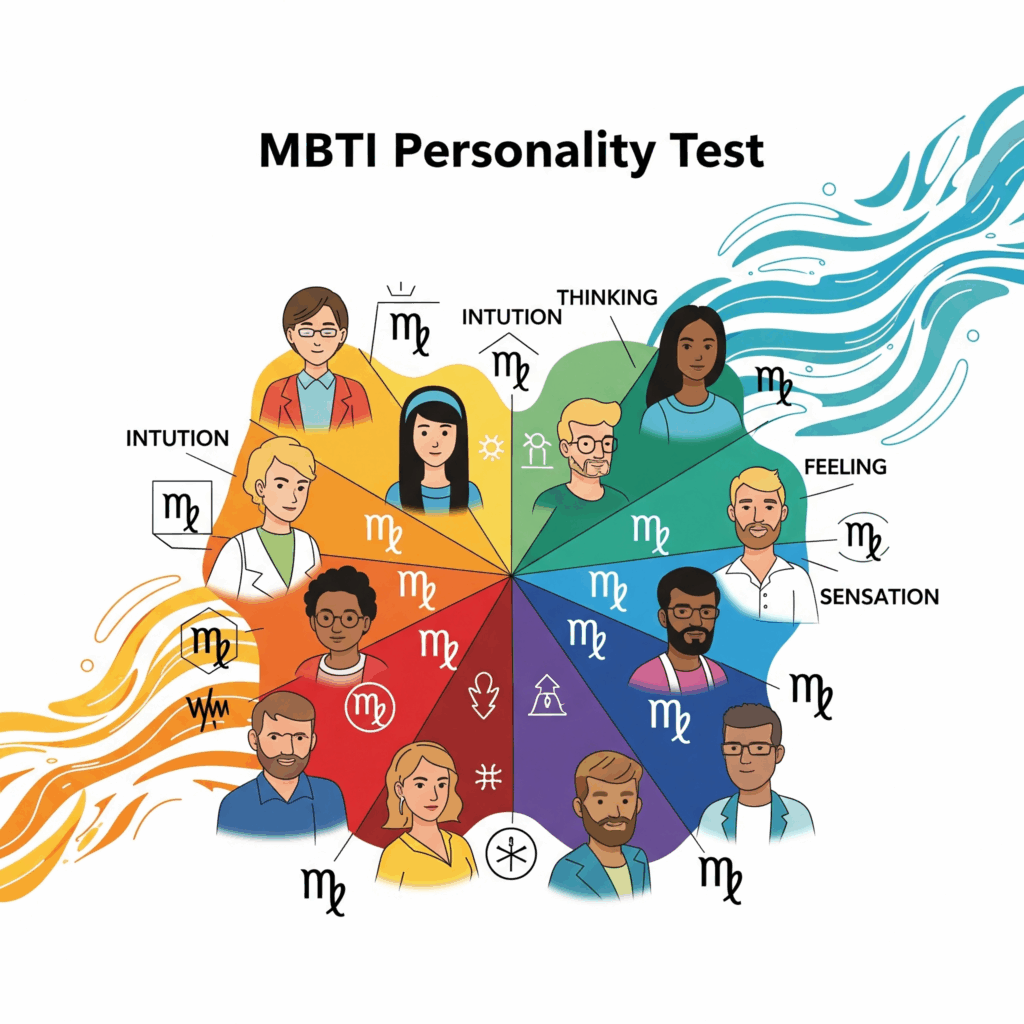
The MBTI classifies your personality across four main “dichotomies,” or pairs of preferences. Each pair represents two opposite ways of behaving or thinking. Your combination of these preferences forms your unique four-letter code, like ISTJ or ENFP. Let’s break them down:
- 1. Extraversion (E) vs. Introversion (I): This is about where you get your energy. Do you feel energized by social interaction (E) or by quiet reflection and solitude (I)? I used to think I was an E, but turns out, I’m more of an I! 🤫
- 2. Sensing (S) vs. Intuition (N): How do you take in information? Do you focus on facts and details you can observe with your senses (S), or do you prefer to look for patterns, possibilities, and abstract concepts (N)?
- 3. Thinking (T) vs. Feeling (F): How do you make decisions? Do you prioritize logic, objective facts, and consistency (T), or do you consider values, personal impact, and harmony (F)? My T-friends often say I’m “too emotional,” but my F-side just wants everyone to be happy! 😊
- 4. Judging (J) vs. Perceiving (P): How do you prefer to live your outer life? Do you like things structured, planned, and decided (J), or do you prefer to be flexible, spontaneous, and open to new options (P)?
Once you’ve figured out your preference for each pair, you combine the letters to get your four-letter MBTI type. There are 16 possible types, and each one has its own unique characteristics and tendencies. It’s actually quite fascinating how accurate it can feel sometimes!
The MBTI Craze in Korea: Why So Popular? 🇰🇷
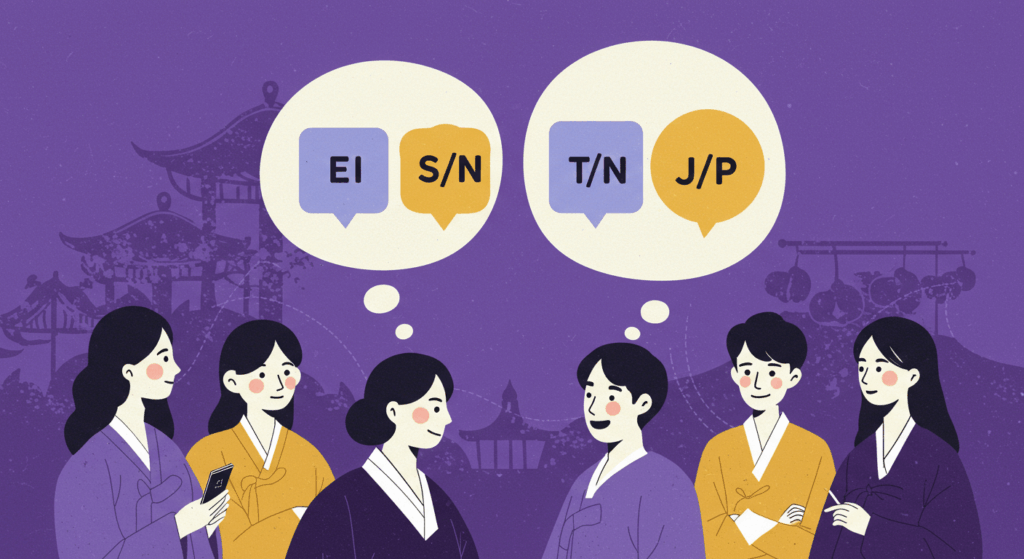
You might be wondering why MBTI has gained such immense popularity in South Korea. Honestly, it’s everywhere! From TV shows to job applications, it’s become a standard topic. My theory? Koreans often value understanding social dynamics and finding common ground. MBTI offers a neat framework for that. It’s a quick and easy way to “size up” someone’s personality without having to spend a ton of time getting to know them deeply, especially in a fast-paced society.
| Reason for Popularity |
Explanation |
| Self-Discovery & Empathy |
People use MBTI to understand their own strengths and weaknesses, and to gain empathy for others by recognizing different ways of thinking. |
| Social Icebreaker |
It provides a fun and non-threatening topic to initiate conversations and find commonalities or interesting differences. |
| Relationship Compatibility |
Many Koreans use MBTI to understand potential romantic partners, friends, or even colleagues, thinking certain types are more compatible. |
| Employment & Marketing |
Some companies even ask for MBTI types in job applications or use it in team-building, and brands use it for targeted marketing. |
While it’s super popular, it’s important to remember that MBTI is just a tool for self-understanding, not a definitive label. It’s like a starting point for conversation, not the whole story!
Taking the MBTI Test: What to Expect 📝
If you’re thinking about taking the MBTI test, you have a few options. The official, certified test is usually administered by a qualified practitioner and can be quite detailed. However, there are tons of free online versions that are widely used in Korea for casual purposes. While not always as accurate, they give you a good idea. My first time, I just did a quick online test, and it was a revelation!
Example: How to Interpret Your Result 💡
Let’s say your result is ENFP:
- E (Extraversion): You likely get energy from being around people and enjoy social gatherings.
- N (Intuition): You tend to focus on possibilities, abstract ideas, and the big picture.
- F (Feeling): When making decisions, you probably prioritize harmony, values, and how others might feel.
- P (Perceiving): You prefer flexibility, spontaneity, and keeping your options open rather than strictly adhering to plans.
So, an ENFP is often seen as an “Advocate” or “Campaigner” – enthusiastic, creative, and social. Does that sound like anyone you know? Maybe even you?
⚠️ Important Note!
Remember that online tests are not official. Your results can sometimes change depending on your mood or the specific questions. Don’t take it too seriously or use it to stereotype yourself or others! It’s meant to be a fun tool, not a strict classification.
Beyond the Letters: Applying MBTI in Daily Life 🤝
The real fun begins when you start applying MBTI to your daily life. It’s not just about knowing your type; it’s about using that knowledge to improve communication and relationships. For example, if you know your friend is an ISTJ (often described as logical and organized), you might approach them with clear facts and a well-thought-out plan, rather than abstract ideas and sudden changes. This doesn’t mean you change who you are, but you can adjust how you communicate to better connect with different types of people.
I’ve personally found it incredibly helpful for understanding why some of my friends react differently than I would, or why I thrive in certain environments and struggle in others. It’s like having a little decoder ring for human behavior! It really helps foster a sense of tolerance and appreciation for diversity in personalities.
Key Takeaways from the MBTI Journey 📝
So, what have we learned about the MBTI phenomenon in Korea? It’s a fantastic tool for self-discovery and understanding others, but it’s important to keep a balanced perspective. Here’s a quick recap:
- It’s About Preferences, Not Skills: MBTI highlights your natural inclinations, not your abilities or intelligence.
- A Conversation Starter: It’s widely used as an icebreaker and a fun way to get to know people in Korea.
- Use with Caution: Don’t use it to label or stereotype others. People are complex and can’t be fully defined by four letters!
- Embrace the Diversity: Understanding different MBTI types can help you appreciate the unique strengths each personality brings.
Frequently Asked Questions ❓
Q: Is MBTI scientifically accurate?
A: While it’s very popular, the MBTI is not considered a scientific psychological instrument by many in the academic community. It lacks empirical evidence for its validity and reliability as a scientific measure of personality. It’s best viewed as a self-assessment tool for personal reflection and group discussion rather than a definitive scientific test.
Q: Can my MBTI type change?
A: The theory suggests your “true” type is relatively stable. However, self-reported results can sometimes change depending on your life experiences, mood, or how you interpret the questions. It’s not uncommon for people to get slightly different results when they retake the test.
Q: Where can I take a reliable MBTI test?
A: For the official, most reliable version, you would need to find a certified MBTI practitioner. However, many free online tests (like the ones on 16Personalities.com) offer a good approximation and are widely used for casual purposes in Korea. Just remember their limitations!
And there you have it! The wonderful, sometimes confusing, but always fascinating world of MBTI in Korea. I hope this helps you understand why it’s such a big part of the culture here and maybe even inspires you to find your own type! If you have any more questions or want to share your MBTI experiences, feel free to leave a comment below~ 😊